
Best Practices for Enablement Managers
Enablement managers sit between the product, the content, and the field. Your job is to make sure what gets built actually changes what team members do on calls. Outdoo AI is built for exactly that: not just to track completion, but to show whether skills practiced in training show up on real calls.
Your core job in Outdoo AI
You own three things in this platform: the agents team members practice against, the scorecards that define what good looks like, and the courses that sequence it all. Get those three right and the rest follows. Get one wrong and the whole system produces noise.
Building an agent library that actually gets used
Match agents to your real pipeline, not a generic sales process
Team members skip roleplay when it feels irrelevant. If your team sells to VP of Engineering at mid-market SaaS companies, the default "cold call with a skeptical buyer" template is not enough. Build agents from your actual best calls, your competitor intel docs, and your most commonly lost deal patterns. Team members practice because it feels like their job.

Build a library structure before you launch
Organize agents by call stage and use case before rolling out to the team. A flat list of 40 agents with names like "Discovery 1," "Discovery 2," and "Discovery v3-final" does not get used. Group by: cold call, discovery, objection handling, demo, renewal, competitive. Team members should be able to find the right agent in under 30 seconds.

Maintain agents when messaging changes
When your positioning changes, your pricing changes, or you launch a new product, update the agents. Agents built on old messaging train team members on things you do not want them to say. Add agent review to your quarterly enablement calendar.
Closing the loop between training and execution
The comparison that matters: roleplay score vs live call score
After a training cohort, pull two numbers for each team member: their average roleplay score on the relevant criteria, and their average live call score on the same criteria in the two weeks after. If the gap is large, the training did not transfer. Either the agents are not realistic enough, or team members need more practice volume before going live. This comparison is the signal enablement needs, not completion rates.
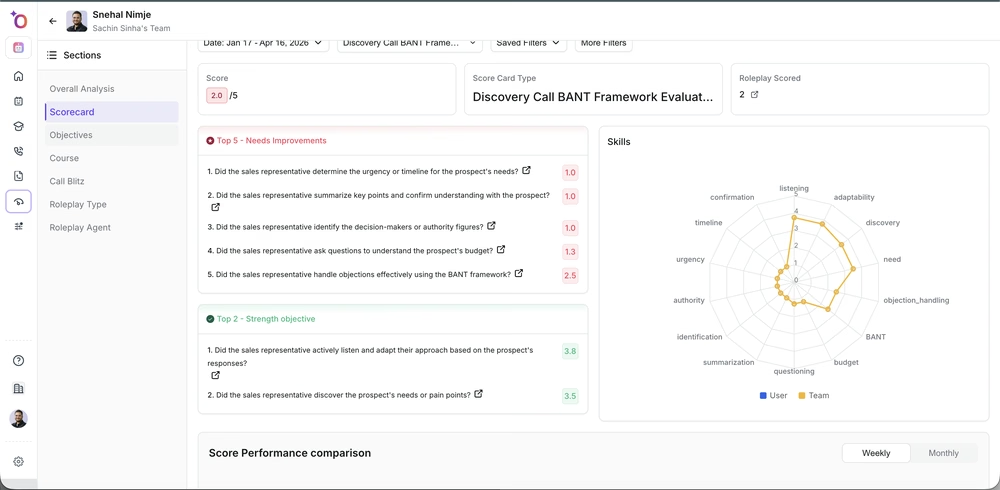
Use real calls to update training continuously
Every week, there are calls happening in your business that are more relevant than any training scenario you built six months ago. Set up a system to surface the best ones: calls where a team member handled a new objection exceptionally well, calls where a new competitor came up, calls where the pricing conversation went sideways. Review them, add them to a Library folder, and use them to update agents quarterly.
Measuring enablement effectiveness
Report on behavior change, not training activity
Completion rates are easy to report and easy to dismiss. The metrics that matter to leadership:
- Did scorecard scores on targeted criteria improve after the training program?
- Are team members who completed the certification performing differently than those who did not?
- Did simulation accuracy translate to fewer CRM data quality issues?
Build your enablement reporting around these, not course completions.
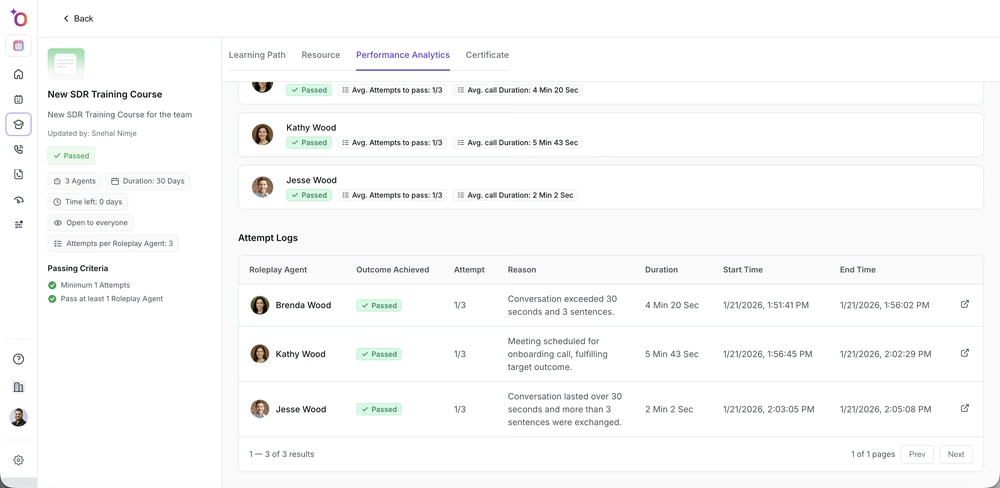
Identify what is not working before leadership asks
If a specific scorecard criterion is consistently low across the team, say 60% average on discovery question quality, that is a training gap, not an individual performance gap. Proactively surface these patterns and build the targeted content before your VP asks why win rates are flat.

Working with other teams
Give managers a view into what team members have practiced
Managers often do not know what their team members have actually practiced and how they performed. Share roleplay completion and accuracy data with frontline managers as part of your regular enablement updates. When a manager knows team member A passed the renewal certification at 90% and team member B has not started, the coaching conversation changes.
Connect simulation to the ops and CRM teams
Workflow simulations are a shared asset with RevOps. When RevOps changes a CRM process, they need to tell you so you can update the simulation. Build that handoff into your change management process before you go live with simulation-based training. It will save you from training team members on a workflow that no longer exists.
Hope this article was helpful. For any queries, please write to support@outdoo.ai